Best Places to Live in Barcelona for International Families
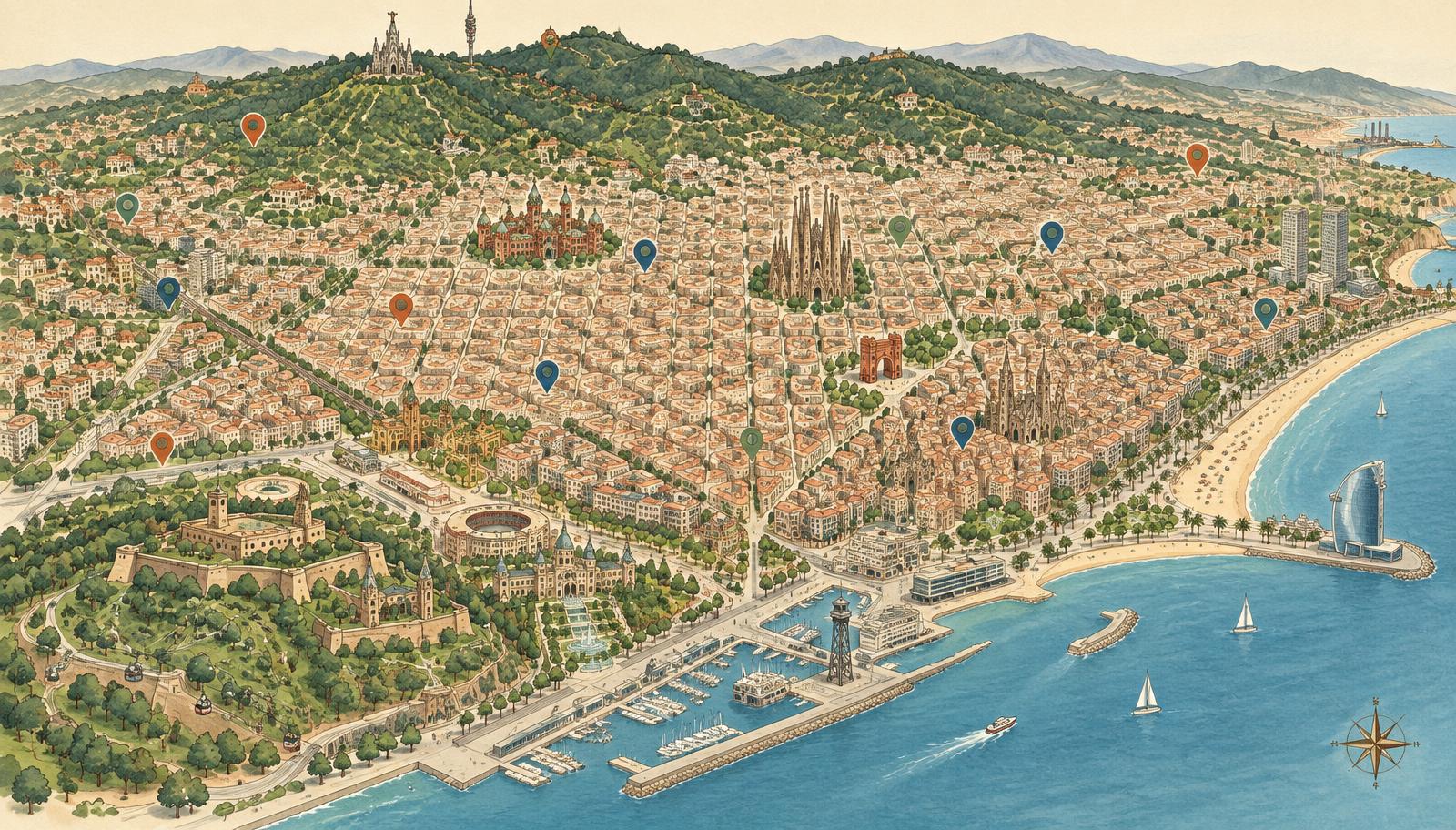
Choosing where to live in Barcelona is not really a property decision. For families with children, it is a decision about the next ten school runs a week, the language your child hears in the playground, and how often you actually get to the beach or the mountains you moved here for.
This guide walks through the neighbourhoods and towns international families choose most often, what each is genuinely like day to day, and how to weigh the trade-offs before you sign anything. If you are still mapping the options, it helps to browse schools in Barcelona alongside the areas below, since the two decisions are hard to separate.
The Five Questions That Decide Where You Live
Before comparing neighbourhoods, answer these honestly as a family.
- How long is your stay? Two years and a global career favours international schools and international-heavy neighbourhoods. Ten years and citizenship plans changes the calculation towards local schools and local neighbourhoods.
- Flat or house? Barcelona city means apartment living, balconies rather than gardens, and shared building life. Gardens mean the suburbs or the coast.
- Who does the school run? A parent working from home in Sant Cugat is a different life to two parents commuting into the city centre at 8am.
- Car or no car? This quietly determines half your options.
- How much local language do you want in daily life? Some pockets of Barcelona let you operate almost entirely in English. Others do not, and that is often a feature rather than a bug.
Barcelona Neighbourhoods at a Glance
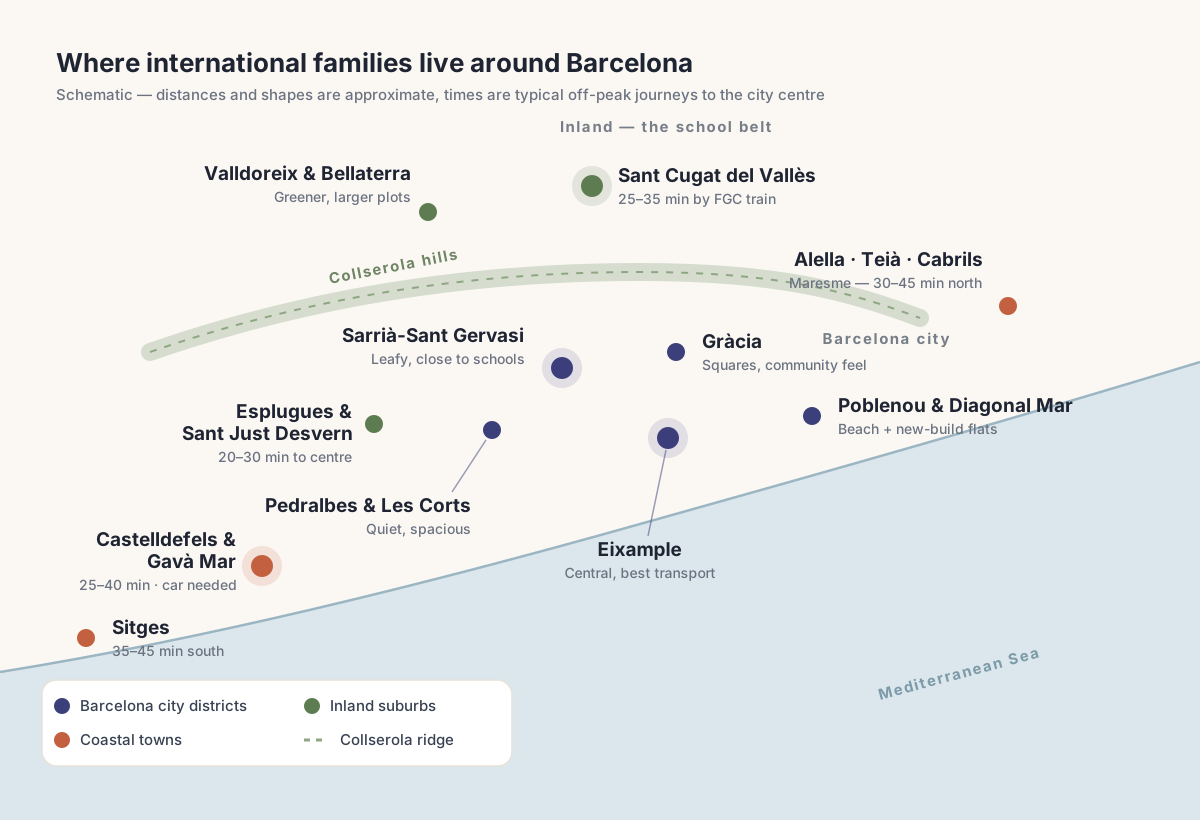
Roughly how the main family areas sit around Barcelona: the city between the Collserola hills and the sea, the school belt inland, and the coastal towns to the south and north. Schematic, not to scale.
| Area | Best for | Housing | Commute to centre | Feel |
|---|---|---|---|---|
| Sarrià-Sant Gervasi | Families wanting city life plus schools nearby | Large flats, some houses | 15–25 min | Leafy, residential, affluent |
| Pedralbes / Les Corts | Proximity to several international schools | Flats, some villas | 15–25 min | Quiet, green, spacious |
| Eixample (Dreta / Esquerra) | Walkable urban family life | Classic high-ceilinged flats | 5–15 min | Central, busy, very well connected |
| Gràcia | Community feel, squares, independent shops | Smaller older flats | 10–20 min | Village-in-the-city, sociable |
| Poblenou / Diagonal Mar | Beach plus modern apartments | New-build flats | 15–25 min | Open, modern, family-friendly |
| Sant Cugat del Vallès | Space, gardens, big international community | Houses with gardens | 25–35 min by FGC | Suburban, calm, family-centred |
| Esplugues / Sant Just Desvern | School access without going far out | Houses and townhouses | 20–30 min | Quiet residential suburb |
| Castelldefels / Gavà Mar | Beach living with schools nearby | Houses near the sea | 25–40 min | Coastal, relaxed, car-dependent |
| Sitges | Seaside town life, strong expat community | Houses and apartments | 35–45 min | Small town, scenic, sociable |
| Alella / Teià / Cabrils (Maresme) | Hillside village life north of the city | Houses with views | 30–45 min | Rural-coastal, quiet |
City Neighbourhoods
Sarrià-Sant Gervasi
The default answer for families who want to stay in Barcelona proper. It is green, calm, safe, well served by FGC trains, and sits close to several private and international schools in the upper city. You get proper neighbourhood life, playgrounds, pharmacies, sports clubs, without giving up the city.
The trade-offs are price and a certain polish. It is one of the most expensive parts of Barcelona, and it can feel less characterful than Gràcia or the old city.
Consider it if: you want the shortest possible school run while keeping city amenities.
Pedralbes and Les Corts
Adjacent to Sarrià and even more spacious in parts, with wide streets, university campuses and a cluster of schools within a short drive. Pedralbes is the closest Barcelona gets to a garden suburb without leaving the city limits.
It is quiet. For some families that is the whole point; for others, especially teenagers, it can feel disconnected from where things happen.
Eixample
The grid. Extraordinary flats, high ceilings, wide pavements, everything within walking distance, and the best public transport in the city. Families who want their children to grow up urban and independent, walking to friends' houses and taking the metro alone at twelve, tend to end up here.
The cost is noise, traffic and limited green space, though the superilles (superblocks) have converted a growing number of streets into car-light play areas. Look at Esquerra de l'Eixample and the streets near Parc Joan Miró or Sagrada Família for the calmest pockets.
Gràcia
The neighbourhood families fall for. Interconnected squares, terraces, independent shops, a genuinely strong community, and a mix of local and international residents. Children's social lives here happen outdoors, in the plaças, which is exactly what many parents come to Spain for.
Flats tend to be older and smaller, buildings often lack lifts, and parking is difficult. Bring less furniture than you think.
Poblenou and Diagonal Mar
Modern Barcelona: new-build apartments, wide seafront promenades, parks, and the beach at the end of the street. Good for younger children, good for anyone working in the 22@ tech district, and generally better value per square metre than the upper city.
The main caveat is schools. Most international options are on the other side of the city, so check bus routes carefully before committing.
The School Belt: Inland Suburbs
Sant Cugat del Vallès
If you asked ten international families in Barcelona where the other nine live, a lot of them would say Sant Cugat. It sits over the Collserola ridge, about 25 to 35 minutes by FGC train into the centre, and it is built around family life: houses with gardens and pools, sports clubs, a pretty old town, a large and easy-to-join international community, and several well-known international schools nearby.
The trade-off is honest suburbia. It is not Barcelona; it is a comfortable, green, slightly bubble-like town near Barcelona. Some families thrive on that and never look back. Others miss the city within a year.
Esplugues de Llobregat and Sant Just Desvern
A middle path. Close enough to the city that a car trip to central Barcelona takes 20 minutes off-peak, quiet enough for houses and gardens, and positioned near a good number of private and international schools on the western edge.
Less international infrastructure than Sant Cugat, but also less of a bubble, and usually more affordable.
Valldoreix and Bellaterra
Even greener neighbours of Sant Cugat, with larger plots and a countryside feel. Excellent if your priority is space and outdoors, provided you accept full car dependence and a longer trip into the city.
The Coast: South and North
Castelldefels and Gavà Mar
Beach on one side, Garraf hills on the other, and an established international community centred on the schools in the area. Children grow up with sand and bikes; many families describe a noticeably slower, healthier rhythm.
Realities to weigh: you will drive for most things, the airport corridor is convenient but the C-32 does get congested, and the town is quieter in winter than the summer visit suggests.
Sitges
A genuinely beautiful seaside town, 35 to 45 minutes south, with a long-standing international and creative community and good connections by train. Family life here is outdoors, sociable and small-town.
It works if your school and work are both south of the city. It is a hard commute if either sits north or inland.
Alella, Teià, Cabrils and the Maresme
North of the city, hillside villages with sea views, vineyards and houses that would be unaffordable inside Barcelona. Quiet, scenic and rooted in local Catalan life, with a handful of international schools along the coast.
Expect to be a car family, and expect Catalan to be more present in everyday life than it is in Sarrià.
Commuting, School Buses and the Daily Reality
Three practical points that change how these neighbourhoods feel.
School buses are common and widely used. Most private and international schools run door-to-door or stop-based routes into the city and the surrounding towns. This can make a school 25 kilometres away entirely workable. Before you rule out a school or a neighbourhood, ask admissions for the actual route map, the pickup time and the annual cost.
Rush hour is real. The C-32, the B-23, the Túnels de Vallvidrera and the Ronda de Dalt all slow considerably between 8am and 9:15am. A 20-minute off-peak drive can be a 45-minute school run in October.
Trains are the quiet advantage. FGC lines to Sant Cugat and the upper city, and Rodalies to Castelldefels and Sitges, are frequent and reliable. Living near a station is worth more to a family than an extra bedroom.
Whatever the map says, do the journey once at 8am on a weekday before you sign.
What It Costs: Rent and Everything Else
Barcelona's rental market moves fast and prices vary widely by street, so treat the following as orientation only.
| Area | Typical 3-bed family home (monthly rent) | Notes |
|---|---|---|
| Sarrià-Sant Gervasi / Pedralbes | €2,500–4,000+ | Premium for space and school proximity |
| Eixample | €2,000–3,200 | Wide range by street and renovation quality |
| Gràcia | €1,800–2,800 | Smaller flats, older buildings |
| Poblenou / Diagonal Mar | €2,000–3,000 | Newer stock, often with parking |
| Sant Cugat | €2,200–3,800 | Houses with gardens at the upper end |
| Castelldefels / Gavà Mar | €2,000–3,500 | Seasonal variation in availability |
| Sitges / Maresme villages | €1,800–3,200 | Wide spread, strongly location-dependent |
Budget beyond rent as well: agency fees and deposits on signing, a car and parking if you go suburban, school transport and lunch, and community fees if you rent a house with shared facilities. Families who move to the suburbs for cheaper rent often find the car, the fuel and the school bus absorb the savings.
Language: What Changes by Neighbourhood
Catalonia is bilingual, and the balance shifts by area. In Sarrià, Sant Cugat, Castelldefels and Sitges you will find large international pockets where English gets you a long way socially. In Gràcia, the Maresme villages and much of the working city, daily life is Catalan first, Spanish second.
This matters most for schooling. Public and concertado schools in Catalonia teach mainly in Catalan, which is entirely workable for younger children and harder for teenagers arriving without either language. Private and international schools operate in English, Spanish, French, German or a combination, which decouples your housing choice from the language question.
Either way, learning some Spanish, and a little Catalan, changes how welcome a neighbourhood feels within a few months.
Matching Your Family to a Place
| If your family… | Look first at |
|---|---|
| Wants city life and short school runs | Sarrià-Sant Gervasi, Les Corts |
| Wants walkable urban independence for teens | Eixample, Gràcia |
| Wants a garden and a big international community | Sant Cugat, Valldoreix |
| Wants beach living and outdoor weekends | Castelldefels, Gavà Mar, Sitges |
| Wants to integrate locally and long term | Gràcia, Poblenou, Maresme villages |
| Is here for two years with a company package | Sarrià, Pedralbes, Sant Cugat |
| Is on a tighter budget with young children | Poblenou, Esplugues, Sant Just Desvern |
Mistakes Families Make When Choosing Where to Live
- Signing a long lease before visiting schools. Rent short-term for the first two or three months if you can.
- Judging the commute from a map. Test it at 8am.
- Choosing on holiday memories. The coastal towns you loved in August are quieter and greyer in February.
- Underestimating flat sizes. Barcelona square metres are smaller than most families expect, and lifts are not guaranteed.
- Ignoring the language of the local school. If you may switch to a public school later, the Catalan question arrives with it.
- Optimising for the parents only. Ask where your children will find friends, sport and independence, not just where the commute is shortest.
Frequently Asked Questions
What is the best area of Barcelona for families with children?
There is no single best area. Families who want city life with walkable schools tend to choose Sarrià-Sant Gervasi, Les Corts, Eixample or Gràcia. Families who want space, gardens and campus-style schools usually look at Sant Cugat del Vallès, Esplugues and Sant Just Desvern, or the coast at Castelldefels, Gavà Mar and Sitges.
Should we choose the school or the neighbourhood first?
It depends. Choose the school first if you need a particular curriculum (IB, British or American), your child is 12 or older, or you're in Barcelona for a few years. Many international schools are outside the city, so the school sets your housing radius. Choose the neighbourhood first if you're staying long term or using local schools: your child's friends, the walk to school and after-school life all happen near home. Either way, test the school run at 8am before you sign a lease.
Is Sant Cugat good for international families?
Sant Cugat del Vallès is one of the most popular choices for international families. It offers houses with gardens, a large international community, several international schools nearby and a direct FGC train to central Barcelona in about 25 to 35 minutes. The trade-off is that it feels suburban rather than urban.
Can we live in central Barcelona and still access international schools?
Yes. Many international schools run private bus routes into central districts such as Eixample, Gràcia and Sarrià. Journey times of 30 to 50 minutes each way are common, so check the exact stop and pickup time before signing a lease.
Do we need a car to live in Barcelona with kids?
In the city, usually not. Metro, bus, FGC trains and walkable neighbourhoods cover most daily needs. In the suburbs and coastal towns, a car is normally essential, and many families end up with two.
Which Barcelona neighbourhoods are the most English-speaking?
Sarrià-Sant Gervasi, Pedralbes, Sant Cugat, Castelldefels and Sitges have the highest concentration of international residents and the easiest soft landing in English. Everyday life outside those pockets runs in Catalan and Spanish.
Is Catalan a problem for international families?
It is a practical factor rather than a problem. Public and concertado schools in Catalonia teach mainly in Catalan, and municipal paperwork is often in Catalan. Private and international schools use English, Spanish or another language of instruction, so the impact depends on your school choice.
How much rent should a family budget in Barcelona?
A three-bedroom family flat in a desirable city district typically ranges from around 2,000 to 3,500 euros per month, while houses with gardens in Sant Cugat, Castelldefels or the Maresme often start around 2,500 and rise well beyond that. Prices move quickly, so treat these as orientation, not quotes.
Is Sitges too far from Barcelona for a school commute?
Sitges is about 35 to 45 minutes by car or train from the city, and it has international schools nearby in the Garraf and Castelldefels area. It works well if your school and work are both south of the city, and less well if either is north or inland.
When should we sign a lease when relocating?
Secure a school place, or at least a firm shortlist, before committing to a long lease. Many families rent short-term for two to three months on arrival, visit schools and neighbourhoods in person, then sign a longer contract once the commute is proven.