Barcelona International Schools: A Practical Guide for Expat Families
In short: International schools in Barcelona follow British, American, IB, French, German or bilingual Spanish programmes, and many sit outside the city in Sant Cugat, Esplugues, Castelldefels or the Maresme. Fees vary widely by school and year group. The right one depends on your child's age, language and next move, so shortlist schools before choosing where to live.
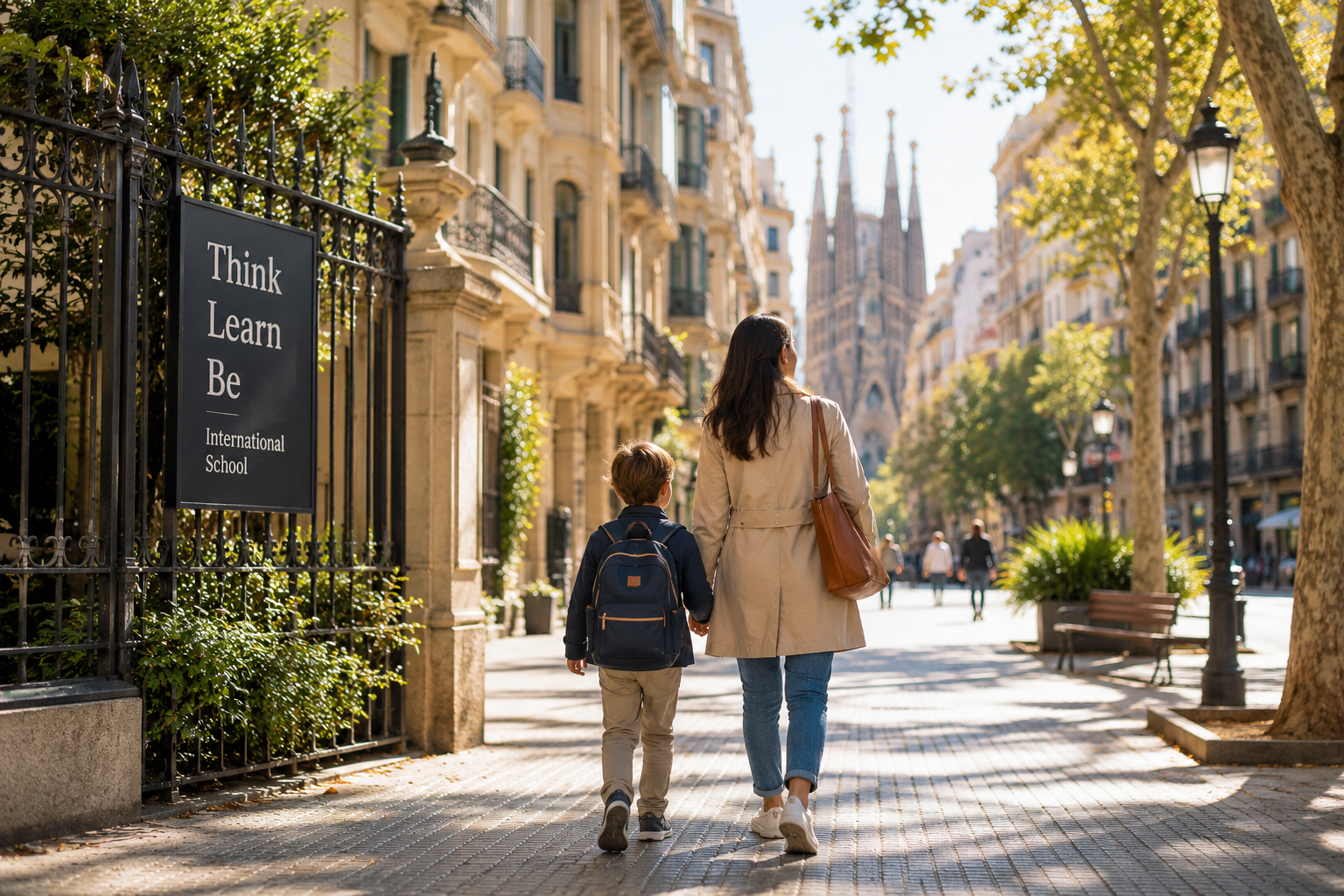
Barcelona is one of those cities that looks easy from the outside.
Sunshine, beaches, good food, walkable neighborhoods, international families, direct flights, mountains nearby. For many parents, it feels like the kind of place where family life should fall into place naturally.
Then you start looking for a school.
That is usually when the simple version of Barcelona disappears.
There are British schools, American schools, French schools, German schools, Swiss schools, Italian schools, IB schools, bilingual schools, private Spanish schools, semi-private schools, Catholic schools, progressive schools, exam-focused schools, city campuses, suburban campuses, waiting lists, bus routes, registration fees, language questions, and a surprising number of opinions from other parents.
Some of those opinions are helpful. Some are outdated. Some are based on one child’s experience. Some are just noise.
This guide is meant to make the process easier. Not by telling you there is one “best” international school in Barcelona, because there isn’t, but by helping you understand the landscape well enough to build a realistic shortlist.
First, What Does “International School” Mean in Barcelona?
In Barcelona, the phrase international school can mean a few different things.
It might mean a school that follows a foreign curriculum, such as British, American, French, German, Swiss, or Italian. It might mean a school that offers the International Baccalaureate. It might mean a Spanish private school with a strong English programme. Or it might simply mean a school with lots of international families.
That distinction matters.
Two schools can both market themselves as international and still feel completely different when you visit. One may be mostly English-speaking, with families arriving and leaving every year. Another may be rooted in the local Catalan and Spanish environment but offer strong English and a more global outlook.
Neither is automatically better. They are just different.
The right question is not “Is this an international school?”
A better question is:
What does international actually mean here, day to day?
That includes the curriculum, the language used in class, the language children use socially, the parent community, university pathways, and how well the school supports children arriving from other countries.
The Curriculum Landscape at a Glance
Here's a quick snapshot of the main curriculum options in Barcelona. Each one is covered in more detail below.
| Curriculum | Common pathway | Best for |
|---|---|---|
| British | IGCSE + A Levels | UK continuity |
| American | High School Diploma / AP / IB | US or flexible university path |
| IB | IB Diploma | Globally mobile families |
| Spanish / bilingual | Spanish system + languages | Long-term Spain integration |
| French / German / Italian | National curriculum | Home-country continuity |
IB, British, American or bilingual?
Most parents asking this are really asking one of four things.
"We might move again in a few years." Look at IB and British schools. The IB Diploma is recognised by universities around the world, and a British school (IGCSEs, then A Levels) is easy to continue in almost any big city. Several Barcelona schools offer the IB Diploma alongside another curriculum, for example Benjamin Franklin International School, the American School of Barcelona and The British College of Gavà. See all IB schools in Barcelona.
"We're American, or might go back to the US." American schools work towards a US High School Diploma, often with AP courses or the IB Diploma in the last two years. Ask about accreditation and where graduates go to university.
"We're staying, and we want our kids to feel at home here." In Barcelona, a "bilingual school" is usually a Spanish or Catalan private school that teaches a large part of the day in English, so in practice your child learns three languages: Catalan, Spanish and English. It's often cheaper than a full international school and children make local friends faster. It's harder for older children who arrive without Spanish. Start with bilingual schools in Barcelona.
"Our child is 14 or older." Choose for continuity first. Switching curriculum in the exam years (IGCSE, IB Diploma or Bachillerato) is the hardest move to make.
The Main Types of International Schools in Barcelona
Barcelona has a broader mix of international school options than many families expect. The choice usually comes down to curriculum, language, location, and long-term plans.
British Schools in Barcelona
British schools are a popular route for international families, especially those moving from the UK or from another British-curriculum school overseas.
Most British schools follow the English National Curriculum, usually moving toward IGCSEs and then A Levels. Some also offer the International Baccalaureate Diploma Programme in the final years.
British schools can be a good fit if you want:
- English as the main academic language
- A familiar structure of year groups, subjects, and exams
- A pathway that keeps UK university options open
- A curriculum that is easy to explain if your family moves again
- A school culture that may feel more familiar to children coming from the UK system
Well-known British curriculum schools in and around Barcelona include The British School of Barcelona, Kensington School, Oak House School, St. George Barcelona, The British College of Gavà, and several others. You can browse the full list of British schools in Barcelona to compare them side by side.
One thing families sometimes miss: British schools in Spain are still schools in Spain. Students will normally study Spanish, and many schools also include Catalan in some form. If you are staying long term, this can be a strength. If you are moving again in a few years, it is still worth understanding how much time is spent on local language requirements.
American Schools in Barcelona
American schools tend to appeal to families from the United States, families who may later return to the US, or families who prefer a broader and more flexible secondary school model.
Depending on the school, students may work toward a US High School Diploma, Advanced Placement courses, the IB Diploma, or a combination of pathways.
American-style schools can be a good fit for families looking for:
- A US-style academic structure
- Strong university guidance
- A broader high school experience
- More flexibility in subject choice
- A school culture that often puts emphasis on activities, student voice, and college preparation
Examples in the Barcelona area include the American School of Barcelona, Benjamin Franklin International School, ES American School, Barcelona High School, and other American or American-influenced options. See the full directory of American schools in Barcelona for current options.
The details matter here. Some American schools are larger and more established. Others are smaller or more flexible. Some feel highly international. Others may have a stronger local or regional identity. If you are considering an American school, ask carefully about accreditation, high school course options, university destinations, learning support, and how many students stay through graduation.
International Baccalaureate Schools in Barcelona
The International Baccalaureate is popular with globally mobile families because it travels well. It is recognized by universities around the world and is built around inquiry, independent thinking, and international-mindedness.
In Barcelona, some schools offer the full IB continuum, while others offer only the IB Diploma Programme in the final two years. You will also find schools that combine another curriculum in earlier years with the IB Diploma at the end.
The IB can be a strong option for students who are:
- Curious and self-motivated
- Comfortable with reading, writing, and research
- Able to manage a demanding workload
- Interested in international university pathways
- Ready for a curriculum that rewards depth, reflection, and independent thinking
That said, the IB is not the easiest path for every student. It can be excellent, but it can also be intense. If your child is entering the final two years of school, ask how the school supports students through the Diploma Programme, which subjects are available, what the workload is like, and how students typically perform. Browse all IB schools in Barcelona to see which ones offer the full continuum versus only the Diploma.
French, German, Swiss, and Italian Schools in Barcelona
Barcelona also has schools connected to other national education systems. These are often excellent choices for families who want continuity with a home-country curriculum or who want their children to become deeply fluent in a specific language.
French schools may follow the French national curriculum. German and Swiss schools may offer pathways connected to German-speaking education systems. Italian schools may suit families looking for continuity with the Italian system.
These schools can make a lot of sense if:
- Your child already speaks the main language
- You may return to that country later
- You want a clear academic pathway into that country’s university system
- Your family culture is connected to that language
- You want your child to become genuinely bilingual or multilingual
For children without the language background, the transition can be harder, especially after the early primary years. A young child may adapt quickly. A teenager may need a very different level of support.
Spanish Private and Bilingual Schools
Not every international family chooses a foreign-curriculum school.
Some families prefer a Spanish private or semi-private school, especially if they plan to stay in Spain long term. These schools may offer a Spanish curriculum with strong English, bilingual teaching, or a more local community with international elements. The bilingual schools in Barcelona directory is a good starting point.
This route can work well for families who want:
- Strong Spanish integration
- More contact with local families
- A deeper connection to life in Barcelona
- A potentially lower-cost option than premium international schools
- A pathway into the Spanish education system
The tradeoff is that the transition can be more demanding, particularly for older children who do not speak Spanish or Catalan. Parent communication may also be less English-led than in a traditional international school.
For younger children, this route can be very attractive. For secondary students, it needs more careful thought.
Where Are Barcelona's International Schools Located?
One of the first surprises for relocating families is that many international schools are not in central Barcelona.
Some are in the city, but many are in nearby towns or residential areas: Sant Cugat, Esplugues, Sant Just Desvern, Castelldefels, Gavà, Sitges, Alella, La Garriga, and the Maresme, among others.
This matters more than people think.
A school can look perfect online and still be a poor fit if the daily commute is exhausting. School choice and housing choice are closely linked in Barcelona. If you need a particular curriculum, shortlist schools first, then decide where to live in Barcelona. If you're staying long term or choosing a local school, many families pick the neighbourhood first.
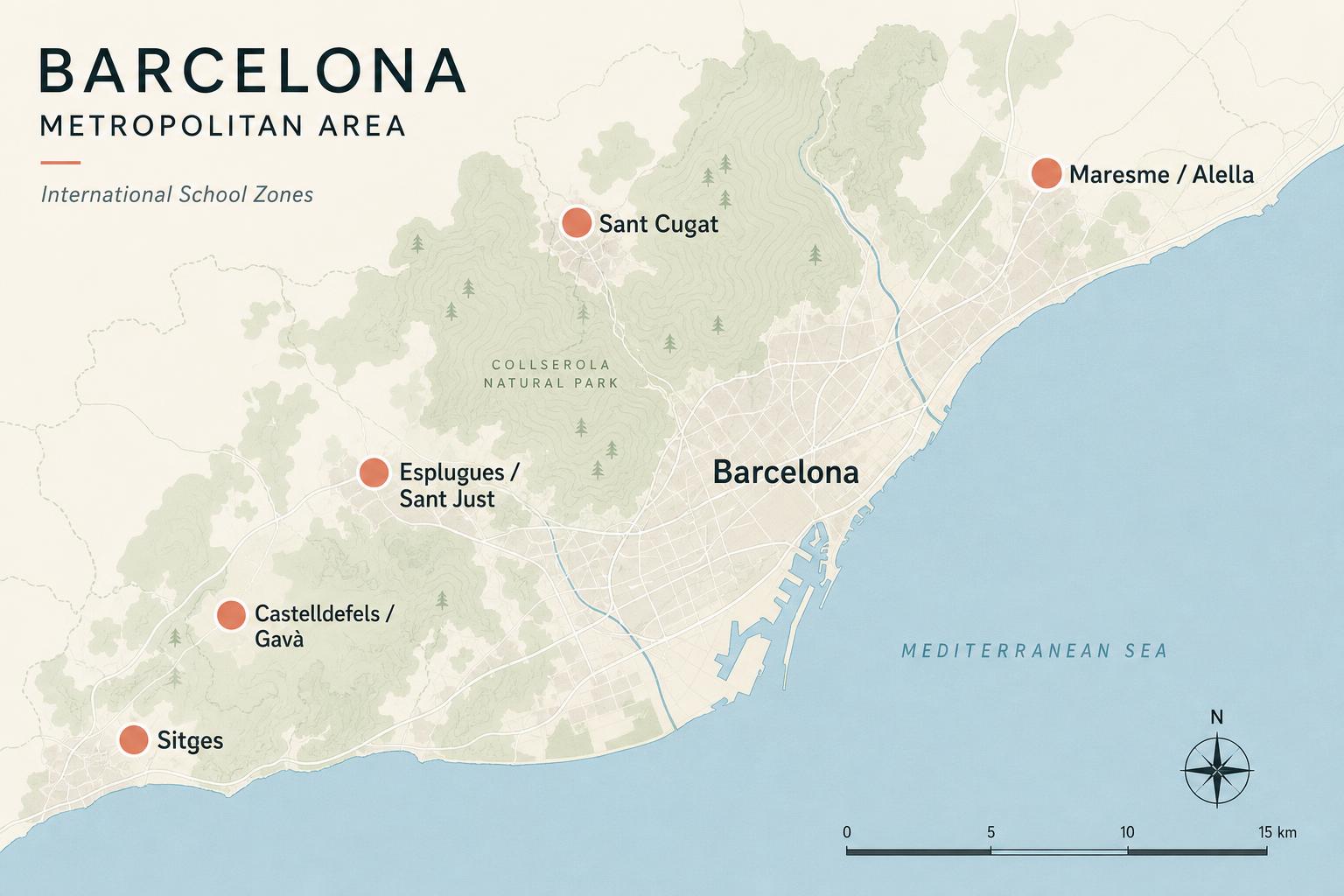
Many international schools sit outside central Barcelona, so school choice and housing choice are often connected.
Barcelona City
Living in the city gives families access to restaurants, culture, public transport, offices, language schools, activities, and a more urban lifestyle. Areas such as Sarrià, Sant Gervasi, Pedralbes, Eixample, Gràcia, and Poblenou are popular with international families.
The tradeoff is space. Schools in the city may have smaller campuses, less outdoor space, or buildings spread across different locations. Some families are happy with that. Others want a larger campus and more green space.
Sant Cugat
Sant Cugat is one of the most popular family areas outside Barcelona. It is greener, quieter, and more residential than the city, with family housing and good connections into Barcelona.
Several private and international schools are located in or near Sant Cugat, which makes it a practical choice for families who want suburban life without feeling too far from the city. They include Agora Sant Cugat International School and the European International School of Barcelona.
Castelldefels and Gavà
Castelldefels and Gavà are popular with families who want a coastal lifestyle, more space, and easier access to the beach. There are international school options in this area and nearby.
The main question is commuting. If one or both parents need to be in central Barcelona often, test the route during real commuting hours before making a housing decision.
Esplugues, Sant Just, and Pedralbes
These areas are close to several well-known international schools and are practical for families who want access to Barcelona without living right in the center. They can be very convenient, but housing can be expensive and competitive.
Sitges and the Garraf Coast
Sitges and neighbouring Sant Pere de Ribes suit families who want a smaller town by the sea. There are international school options in both, so some families here can keep the school run local. If a parent commutes into Barcelona, check train and motorway times at rush hour, because the coastal route has few alternatives.
The Maresme and the Vallès
North of the city, the Maresme coast (towns such as Montgat, Cabrera de Mar and Canet de Mar) and the Vallès inland (La Garriga, Llinars del Vallès, Terrassa) each have international or bilingual school options. Schools here are spread out, so the distance between home and school matters more than in the city. Ask each school whether it runs buses and which towns they cover.
How Many Schools Are in Each Area?
Of the Barcelona-province schools currently listed on SchoolFinder Spain, 24 are in Barcelona city, 3 in Esplugues de Llobregat, 2 each in Sant Cugat del Vallès, Gavà and Sant Pere de Ribes, and 1 each in Sitges, Castelldefels, Sant Joan Despí, El Prat de Llobregat, Montgat, Cabrera de Mar, Canet de Mar, La Garriga, Llinars del Vallès and Terrassa. These counts reflect our directory, not every school in the region, and change as schools are added.
Matching an Area to a School
- Shortlist schools first. Pick two or three schools that fit your child's curriculum and language needs, then look at housing around them.
- Check the bus map. Ask each school for its current bus routes and stops. Routes can change from year to year.
- Test the journey at school times. Drive or ride the route at drop-off and pick-up time from the exact streets you are considering.
- Think about after school. Ask whether activities run on campus or nearby, and how children get home afterwards.
- Ask about siblings. If children will be in different stages, check whether they share one campus or are split across sites.
How Much Do International Schools in Barcelona Cost?
Fees vary widely.
Some bilingual or Spanish private schools are more affordable. Premium international schools, especially in secondary and high school, can be much more expensive.
As a rough planning range, many international schools in the Barcelona area sit somewhere between about €8,000 and €25,000+ per year, depending on the school, age of the child, curriculum, and what is included. Some high school programmes can go higher once you include registration, exams, lunch, transport, and other costs.
The headline tuition number is only part of the story.
When comparing schools, ask for the full cost of:
- Application fees
- Registration or enrollment fees
- Capital or foundation contributions
- Tuition
- Lunch
- School bus
- Books and materials
- Technology fees
- Uniforms
- Public exam fees
- Extracurricular activities
- Trips
- After-school care
The first year is often more expensive than later years because of one-time fees.
A useful question to ask admissions is:
What is the total first-year cost, and what is the expected recurring annual cost after that?
Those two numbers are not always the same.
Language: The Detail That Changes Everything
Language is one of the biggest factors in choosing a school in Barcelona.
It is also one of the easiest things to misunderstand.
A school may describe itself as English-speaking, bilingual, multilingual, international, or Spanish-English. Those labels help, but they do not tell the full story.
You need to understand three different language layers.
1. The Language of Instruction
This is the language used to teach core subjects. In a British or American school, that will usually be English. In a French school, French. In a German school, German. In a Spanish or bilingual school, it may be Spanish, Catalan, English, or a mix.
2. The Social Language
This is what children actually speak at lunch, in the playground, on WhatsApp, at birthday parties, and during group work.
For your child’s happiness, this may matter as much as the official language of instruction.
A school can teach in English while students socialize mainly in Spanish. Another school may have a genuinely mixed-language environment. Another may be dominated by one language group.
Ask current parents, not just admissions.
3. The Parent Language
This is the language used in emails, meetings, parent groups, events, and day-to-day communication.
If one parent does not speak Spanish or Catalan, this can affect how connected the family feels to the school community.
A better question than “Is the school bilingual?” is:
How are English, Spanish, and Catalan actually used in class, socially, and with parents?
That answer will tell you much more.
Admissions: When Should You Apply?
Popular international schools in Barcelona can fill places early, especially in certain year groups.
If you are moving from abroad, it is sensible to start researching 9 to 18 months before your intended start date. That said, international schools are used to relocating families, and some do accept students throughout the year if places are available.
The admissions process usually includes some combination of:
- Initial inquiry
- School tour or video call
- Application form
- Previous school reports
- Passport or identity documents
- Teacher references
- Academic or language assessment
- Student interview
- Parent interview
- Enrollment deposit
For a step-by-step walkthrough, see our guide on how to apply to an international school in Spain.
For younger children, admissions may focus more on readiness, language background, and fit. For older students, the process can be more selective, especially if the child is entering GCSE, A Level, IB Diploma, Bachillerato, or the final years of an American high school programme.
If your child is already in secondary school, be especially careful about switching systems. It may still be possible, but the timing matters.
How to Choose the Right International School in Barcelona
Most school searches start with reputation. That is understandable, but it is not enough.
The most famous school is not always the right school for your child. The school other parents love may not be the one where your child will thrive.
Start with your child, then work outward.
Curriculum Fit
Think about where your child may study next.
Will you return to the UK? Move back to the US? Stay in Spain? Move again to another international city? Apply to universities in Europe? Keep all options open?
Curriculum matters because it affects transferability, exams, university entry, and stress levels.
Ask yourself:
- Do we need continuity with a previous school system?
- Are we likely to move again?
- Which university systems should remain open?
- Is my child better suited to exams, coursework, projects, or inquiry?
- How difficult would it be to change curriculum later?
Language Goals
Be honest about what you want.
Some families want their children to stay academically strong in English. Others want them to become fluent in Spanish. Some want Catalan integration. Others want French, German, or Italian continuity.
Younger children usually have more flexibility. Older children need a more careful transition.
Ask the school:
- What support is available for children who do not speak the main language?
- How quickly do new students usually adapt?
- What language do children use socially?
- How much Spanish and Catalan will my child learn?
- Will this pathway keep Spanish university options open?
Commute and Daily Life
The commute can shape your family’s entire experience.
Before choosing a school, test the journey at real school-run times. Do it from the neighborhoods where you are actually considering living. Check the school bus route, not just the driving distance on Google Maps.
Ask:
- Is there a school bus?
- Where are the stops?
- How long is the ride?
- What time would my child leave home?
- Can we manage after-school activities?
- Will classmates live nearby?
A long commute does not always ruin the experience, but it should be a conscious decision.
School Culture
This is the hardest thing to capture on a website.
Some schools are academic and structured. Some are warm and nurturing. Some are competitive. Some are relaxed. Some have a very international parent body. Others are more local. Some are polished during admissions but less responsive once you are enrolled.
Try to understand the real culture.
Ask current parents:
- What kind of child does well here?
- What kind of child might struggle?
- How does the school handle behavior?
- Are teachers approachable?
- How does leadership communicate?
- Do parents feel listened to?
Wellbeing and Support
Relocating can be exciting for children, but it can also be lonely, confusing, and tiring. Even confident children may struggle at first.
This is why wellbeing support matters.
Ask about:
- Pastoral care
- Counseling or psychology support
- Bullying response
- Friendship integration
- Learning support
- Support for neurodiverse students
- Communication with parents
- Transition support for new arrivals
A school's academic results are important. But for a child arriving in a new country, feeling safe and included comes first.
Before You Choose a School in Barcelona
- ✓ Curriculum pathway
- ✓ Main language of instruction
- ✓ Social language among students
- ✓ Commute from home
- ✓ Full first-year cost
- ✓ Waiting list status
- ✓ Learning support
- ✓ Wellbeing and pastoral care
- ✓ University pathway
- ✓ Parent feedback
Once you have a shortlist, you can compare two schools side by side on curriculum, fees, ages and location.
Questions to Ask on a School Tour
School tours can be polished. That is not a bad thing, but it means parents need to ask specific questions.
Here are the ones worth bringing with you.
Academic Questions
- What curriculum do you follow?
- What qualifications do students receive?
- How do students transition from other school systems?
- What happens if a student struggles academically?
- How much homework should families expect?
- What are typical university destinations?
- How are teachers evaluated and supported?
Language Questions
- What is the main language of instruction?
- How are Spanish and Catalan taught?
- What language do students use socially?
- Is language support available for new arrivals?
- How do you communicate with parents?
- Are parent meetings available in English?
Culture and Wellbeing Questions
- What type of child tends to thrive here?
- What type of child may find the school less suitable?
- How do you help new students make friends?
- How do you handle bullying or social issues?
- What pastoral support is available?
- How easy is it for parents to speak with teachers or leadership?
Practical Questions
- Which year groups have waiting lists?
- What is the full first-year cost?
- What is included in tuition?
- What is not included?
- Is there a school bus?
- Where do most families live?
- What extracurricular activities are available?
- What is the withdrawal policy?
Common Mistakes Families Make
Choosing Based on Reputation Alone
A school can have a strong reputation and still not be the right fit. Reputation is useful as a starting point, not a final decision.
Ignoring the Commute
A 25-minute drive on a quiet afternoon may become 50 minutes during the morning school run. Test the route properly.
Assuming “International” Means English-Speaking
Some international schools are English-led. Others are French, German, Italian, bilingual, or multilingual. Always ask what language is used in class, socially, and with parents.
Looking Only at Primary School
If your child is young, it is natural to focus on the early years. But fees, curriculum, academic pressure, and school culture can change significantly in secondary.
Not Speaking to Current Parents
Admissions teams can explain the official version. Current parents can explain the lived version. You need both.
International or local school? It depends on age and how long you're staying
Short answer: If you're in Barcelona for a few years, or your child is 12 or older and doesn't speak Spanish or Catalan, an international school can make the move easier. If you're staying long term and your child is younger, a local public or concertado school can be the better route: many children learn Catalan and Spanish quickly and make friends near home.
| Child's age | What families often find | Worth asking |
|---|---|---|
| Under 8 | Many children pick up Catalan and Spanish quickly at a local school, especially with support in class. | Does the school offer extra language support for new arrivals? |
| 8 to 11 | It depends on the child. Local school can work well; some families start international and switch later, but the longer they wait, the bigger the Catalan gap. | If we switch to a local school later, what level of Catalan will be expected? |
| 12 and older | Joining a local secondary school without Catalan is hard, because coursework is taught in it. Some families choose an international school, or a school that keeps the same curriculum. | Which curriculum keeps exam years steady for my child? |
Whichever you choose, ask about the mix of families in your child's year group, not just the whole school.
Which Type of School Fits Which Family?
There is no perfect formula, but these patterns can help.
If You May Move Again
Look at British, American, and IB schools with internationally transferable pathways and experience supporting globally mobile families.
If You Plan to Stay in Spain Long Term
Consider bilingual schools, Spanish private schools, or international schools with serious Spanish and Catalan integration.
If Your Child Is Already a Teenager
Prioritize curriculum continuity. Changing systems late can be difficult, especially around exam years.
If Your Child Is Very Young
You have more flexibility. Younger children often adapt more easily to multilingual environments and local school cultures.
If English Continuity Is Essential
Focus on schools where English is the main language of instruction, not just a strong subject.
If Local Integration Matters Most
Look closely at Spanish private, bilingual, or semi-private options, and ask how international families are supported.
Browse international schools in Barcelona
Filter by curriculum, language, neighborhood, and fees — and compare schools side by side.
Final Thoughts
Choosing an international school in Barcelona is not just about academics.
It affects where you live, who your children become friends with, what languages they learn, how your family settles, and what future options stay open.
Barcelona has many good schools. That is the good news.
The harder part is knowing which good school is right for your child.
Start with the practical questions: curriculum, language, commute, fees, and admissions. Then look deeper at culture, wellbeing, parent community, and the type of child who genuinely thrives there.
A school does not need to be perfect on paper. It needs to be a place where your child can belong, learn, and build a happy life in Barcelona.
Frequently Asked Questions About International Schools in Barcelona
Which international schools in Barcelona offer the IB?
Several schools in and around Barcelona offer the IB Diploma in the last two years, often alongside a British or American curriculum, and a few offer IB programmes from younger ages. Our IB schools in Barcelona list shows which ones, and each profile says whether it offers the full IB or the Diploma only.
What's the difference between an international school and a bilingual school in Barcelona?
An international school follows a foreign curriculum (British, American, IB, French, German) and usually teaches mainly in that language. A bilingual school is usually a Spanish or Catalan private school with a lot of English, so children follow the Spanish system and learn Catalan, Spanish and English. Bilingual schools often cost less and suit families staying long term.
How much do international schools in Barcelona cost in 2026–27?
Fees vary widely by school and year group, with secondary usually the most expensive. Budget separately for registration, lunch, the school bus, books and exam fees, and ask each school for the full first-year cost.
Are there international schools in Barcelona that suit local families too?
Yes. Many international schools have a mix of Spanish and international families, and some combine a British or American curriculum with the Spanish one. Families who want strong Spanish and Catalan alongside English often look at bilingual or Spanish private schools as well.
Which British schools are there in Barcelona?
British-curriculum schools in and around Barcelona include The British School of Barcelona (several campuses), Kensington School, Oak House School, St. George Barcelona, The British College of Gavà and Richmond International British School. See the full list of British schools in Barcelona.
What is the best international school in Barcelona?
There is no single best school for every family. The right choice depends on your child’s age, language level, curriculum needs, personality, budget, commute, and future plans.
Do international schools in Barcelona teach Spanish?
Most do. Even schools where English, French, German, or another language is the main language of instruction usually include Spanish. Many also include Catalan in some form.
Can expat children attend public schools in Barcelona?
Yes. Expat children can attend public schools in Spain. In Catalonia, public schools generally operate within the Catalan education system, so Catalan is an important language. This can work well for younger children or families staying long term, but it may be more challenging for older children arriving without Spanish or Catalan.
Should we choose a school before choosing where to live?
Often, yes. Because many international schools are outside central Barcelona, school choice and housing choice are closely connected. It is usually better to shortlist schools first, then choose a neighborhood based on commute and daily life.
Are there waiting lists for international schools in Barcelona?
Some schools and year groups do have waiting lists. Availability changes by school, age, and timing, so it is worth contacting admissions teams early.