Spain's School System Explained: A Guide for Expat Parents
In short: Spain's education system has four stages: Infantil (0 to 6), Primaria (6 to 12), ESO (12 to 16), then Bachillerato or vocational training. School is compulsory from 6 to 16. Families choose between free public schools, low-fee concertado schools, private schools and international schools, and in some regions, such as Catalonia, lessons are mainly in a regional language.
Moving to Spain with children often means learning a whole new school vocabulary: Infantil, Primaria, ESO, Bachillerato, concertado, homologación, bilingual, international. Some of it sounds familiar. Some of it absolutely is not.
This guide explains how the Spanish education system works, what choices families usually face, and the questions worth asking before choosing a school.
How Spain's Education System Is Organised
Spain's national education system is built around four main stages, and compulsory schooling runs from ages 6 to 16. However, most children start school earlier — the majority of families enrol their children in preschool from age 3.
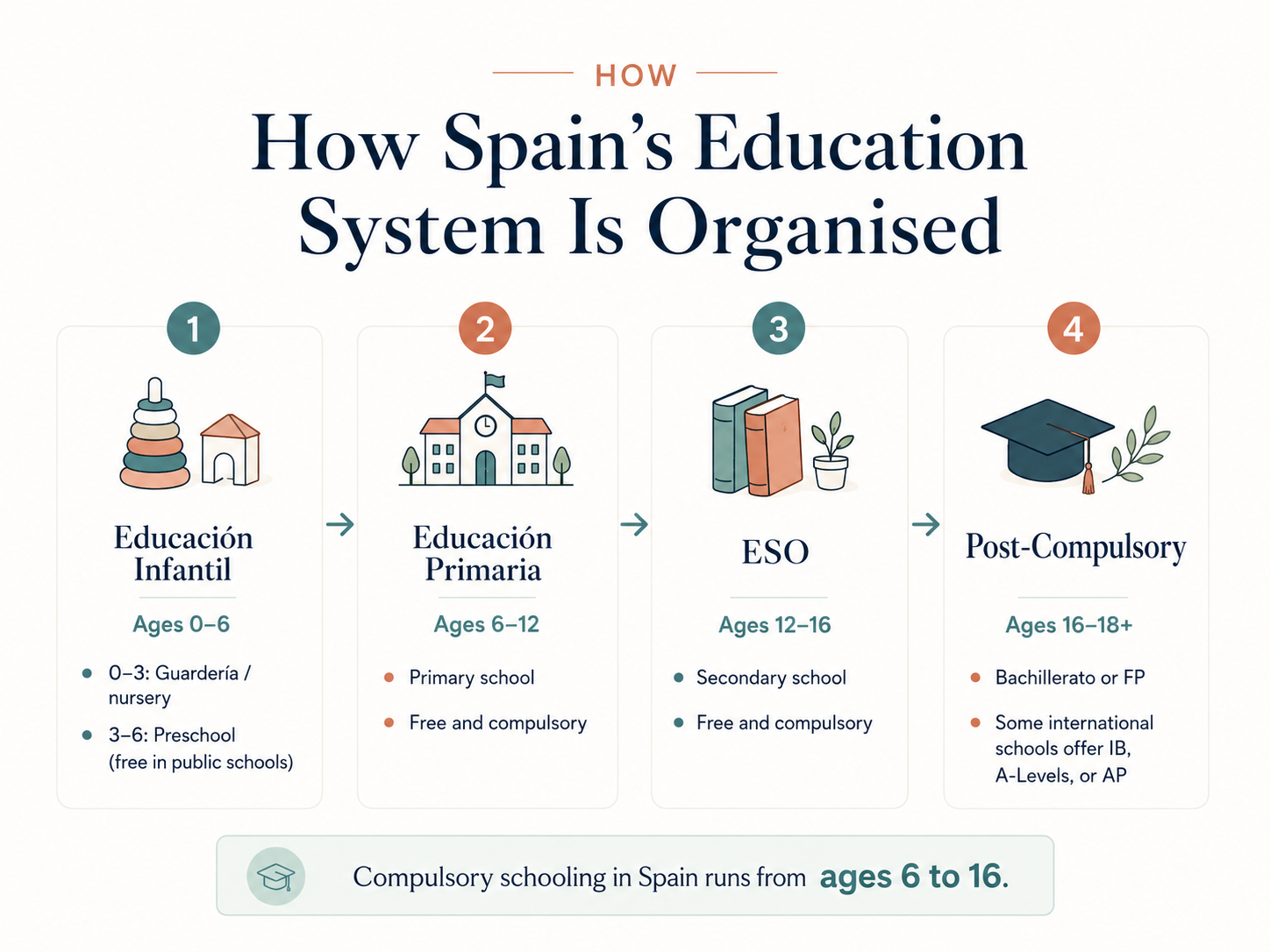
Here's a quick overview of each stage.
Stage 1: Educación Infantil (Ages 0–6)
This is early childhood education, split into two cycles:
- First cycle (0–3 years): Nurseries, known as guarderías or escuelas infantiles. These are generally fee-paying, even in the public sector.
- Second cycle (3–6 years): Free and widely available in public schools. Though not compulsory, the vast majority of Spanish families take advantage of it. These preschool years are crucial for language immersion and social development.
For expat families, this second cycle is often where children begin picking up Spanish (and in some regions, Catalan or Valencian) naturally through play.
Stage 2: Educación Primaria (Ages 6–12)
Primary school lasts six years and is free and compulsory. Children study a broad curriculum covering literacy, maths, natural sciences, social sciences, art, PE, and a foreign language — almost always English.
Spanish primary school focuses on building strong academic foundations in a relatively relaxed environment. School hours vary by region and school; see our school hours in Spain guide.
Stage 3: Educación Secundaria Obligatoria — ESO (Ages 12–16)
This is the equivalent of secondary school and lasts four years. It is compulsory and free in public schools. At the end of ESO, students receive a qualification that opens the door to further education.
The curriculum becomes more subject-specific here, and students begin to encounter a wider range of teachers and subjects. In international schools, this stage often aligns with preparation for IGCSE or equivalent qualifications.
Stage 4: Post-Compulsory Education (Ages 16–18+)
After completing ESO, students have two main paths:
- Bachillerato: A two-year academic track leading to the Selectividad (university entrance exam), now called the EVAU or EBAU depending on the region.
- Formación Profesional (FP): Vocational training, which has gained significantly in prestige in recent years.
Students in international schools may instead follow the IB Diploma Programme, A-Levels, or the American curriculum's Advanced Placement (AP) courses — all widely accepted by Spanish and international universities.
The Four Types of Schools in Spain
Understanding the difference between school types is perhaps the most important thing for any expat family. Spain has four main categories, and the right choice depends on your family's priorities, budget, and timeline.
The school choice map for international families in Spain
A simple visual with four paths:
| If your priority is… | School types to explore | Main question to ask |
|---|---|---|
| Local integration | Public, concertado, Spanish private | What language do children actually use day to day? |
| Language balance | Concertado, bilingual private, international | What does "bilingual" mean in practice? |
| Curriculum continuity | International or national curriculum schools | Will this curriculum transfer if we move again? |
| University pathway clarity | IB, British, American, Spanish Bachillerato | Which university systems does this pathway support best? |
1. Public Schools (Colegios Públicos)
Public schools are free and open to all children living in Spain, regardless of nationality or documentation status. They follow the national curriculum and are managed by Spain's regional governments — which is why there are variations depending on whether you live in Catalonia, Madrid, or Valencia.
Best for: Families planning a long-term stay who want full cultural and linguistic integration. Children typically pick up Spanish quickly through immersion.
Things to know: Admission is based on a points system tied to your proximity to the school, whether you have siblings enrolled, and in some cases income. Applying during the correct window (usually spring) is essential.
2. Concertado Schools (Semi-Private)
Concertados are privately managed but receive public funding, meaning fees are significantly lower than fully private schools — often just a few hundred euros a year for activities and materials. Many are affiliated with the Catholic Church, though secular concertados exist.
Best for: Families who want a middle ground — a degree of structure and values-based education without the full cost of private schooling.
Things to know: Like public schools, concertados use a points-based admissions system. They can be very popular and oversubscribed in desirable areas.
3. Private Schools (Colegios Privados)
Fully private schools charge fees and operate independently of the state curriculum, though they must still meet minimum national standards. They often offer smaller class sizes, more extracurricular activities, and bilingual programmes.
Best for: Families who want a strong academic environment with more English instruction but prefer a school grounded in the Spanish system.
Things to know: Annual fees typically range from €4,000 to €12,000 or more depending on the school and city. Browse private schools in Barcelona to see what's available.
4. International Schools
International schools teach primarily in English (or another language) and follow a foreign curriculum — typically British (leading to IGCSEs and A-Levels), American (AP courses), or the International Baccalaureate (IB). They are accredited by international bodies and their qualifications are recognised globally.
Best for: Families on shorter postings, those uncertain about the length of their stay, or families who want their children to maintain academic continuity with their home country's system.
Things to know: These are the most expensive option. Annual fees in Barcelona and Madrid typically range from €8,000 to €25,000+ depending on year group and school prestige. See our dedicated guide to international schools in Barcelona for a deeper dive.
Public schools in Barcelona
Free, state-funded schools open to all children living in Spain.
Concertado schools in Barcelona
Semi-private schools with modest fees and a mix of state funding.
Private schools in Barcelona
Independent schools with smaller classes and bilingual programmes.
International schools in Barcelona
British, American, and IB curriculum schools recognised globally.
Key Differences by Region: Barcelona, Madrid, and Valencia
One important thing to understand about Spain is that education is decentralised. Each of the 17 autonomous communities sets its own education policies on top of the national framework — and this affects language of instruction significantly.
- Barcelona (Catalonia): Catalan is the main language of instruction in public and concertado schools, with Spanish also taught. This surprises many expat families. International schools teach in English and are less affected by this.
- Madrid: Spanish is the primary language of instruction in public schools. Madrid has one of the highest concentrations of international and bilingual schools in the country.
- Valencia: Valencian (a variety of Catalan) and Spanish are both used in local schools. The city has a growing international school sector catering to a rising expat and digital nomad population.
What Are School Hours in Spain?
School hours in Spain aren't set nationally. Most primary schools start around 9:00 and finish around 14:00 (continuous day) or 16:30 (split day with a long lunch break). Secondary schools often run from about 8:00 to 14:30, and international schools from about 9:00 to 16:30. Our guide to school hours in Spain explains split vs continuous days, lunch, shorter days in June and September, and the differences by region.
School calendar
The school year runs from September to June. Exact start and end dates, Christmas and Easter breaks and local holidays are set by each autonomous community, and some schools shorten the day in September and June (jornada intensiva). Check your region's official school calendar for the current year, or see our school holidays in Spain guide for the 2026–27 dates in Barcelona, Madrid, Valencia and Málaga.
Questions to ask the school: What time does the day start and finish for my child's year group? Is it a split or continuous day? Are hours shorter in September and June? What do early drop-off, lunch and after-school care cost?
What About Language Support for Non-Spanish-Speaking Children?
This is understandably one of the biggest concerns for expat parents. The good news is that Spanish children are famously welcoming, and most schools are experienced in helping new arrivals settle in.
Public and concertado schools typically offer some level of Spanish language support. In international schools, English Language Acquisition (ELA) or English as an Additional Language (EAL) programmes are standard. Some schools charge extra for this support, so it's worth asking during the admissions process.
Quick Summary: Which School Type Is Right for Your Family?
| Situation | Recommended school type |
|---|---|
| Short-term posting (1–3 years) | International school |
| Long-term move, tight budget | Public school |
| Long-term move, moderate budget | Concertado or bilingual private |
| Want continuity with UK/US system | British or American international school |
| Want global university recognition | IB school |
| Planning to return to local system | Spanish private or bilingual school |
FAQs
Is school compulsory in Spain?
Yes. Compulsory education in Spain runs from age 6 to age 16, covering Educación Primaria and Educación Secundaria Obligatoria (ESO). However, most children start school earlier, with the second cycle of Educación Infantil (ages 3–6) being free and almost universally attended.
Can expat children attend public schools in Spain?
Yes. Public schools are free and open to all children living in Spain regardless of nationality or documentation status. Admission is typically based on a points system tied to proximity, siblings, and sometimes income, and applications usually open in spring.
What is the difference between a public, concertado and private school?
Public schools are state-funded and free. Concertado schools are privately managed but partly state-funded, so fees are usually modest. Private schools are fully independent and charge full fees. International schools are a sub-set of private schools that follow a foreign curriculum such as British, American or IB.
What language are public schools taught in?
It depends on the region. In Madrid, public schools teach primarily in Spanish. In Catalonia (including Barcelona), Catalan is the main language of instruction, with Spanish also taught. In the Valencia region, both Valencian and Spanish are used.
How much do private and international schools cost in Spain?
Spanish private schools typically range from €4,000 to €12,000 per year. International schools in Barcelona and Madrid usually range from €8,000 to €25,000+ per year depending on the year group and school.
When does the Spanish school year start?
The Spanish school year runs from September to June. Exact start and end dates, holidays and breaks are set by each autonomous community.
What are school hours in Spain?
School hours are not set nationally. They depend on the region, the stage and the school. Some schools run a split day (jornada partida), for example around 9:00–12:30 and 15:00–16:30 in many Catalan public primary schools. Others run a continuous day (jornada continua) that often finishes around 14:00. Private and international schools set their own hours, so check the timetable of each school.
Do Spanish schools support children who don't speak Spanish?
Most do. Public and concertado schools typically offer some form of Spanish language support for new arrivals, and international schools offer English as an Additional Language (EAL) programmes. Some schools charge extra for this support, so ask during admissions.
Next Steps
Understanding the framework is just the beginning. Once you know which type of school fits your family, the next step is researching specific schools in your city, understanding the admissions timelines, and planning ahead — especially for popular international schools, which can have waiting lists of a year or more.
Explore our city-specific guides to go deeper:
- International schools in Barcelona
- International schools in Madrid
- Schools in Valencia
- How to apply to an international school in Spain
And if you're weighing up the IB vs. British vs. American curriculum, our curricula comparison will help you make sense of the options.